
.svg)
5 costly compliance traps when hiring employees in canada from the US


U.S. tech companies that hire Canadian developers learn an $847,000 lesson the hard way. Canada is not one country under employment law. It’s 10 provinces and 3 territories, each with different rules. These rules can turn a simple hire into a compliance nightmare.
Most U.S. companies treat Canada as a unified market, similar to hiring across U.S. states. The reality is more complex. Each province sets its own statutory holiday requirements, termination notice periods, mandatory benefits, and enforcement mechanisms. FMC Group reports 86% of HR leaders cite international compliance as their top challenge when managing cross-border teams. Misclassification alone triggers 20-30% penalties on gross payments, plus back-taxes and interest.
The stakes are real. One case resulted in $847,000 in retroactive liabilities for a 12-person team. Generic multi-country EOR providers spread thin across dozens of jurisdictions miss these provincial nuances. Here are the five main traps that cost U.S. companies the most.It includes province-by-province breakdowns and real examples from tech hiring.
Statutory holiday requirements vary dramatically by province
Quebec requires 8 statutory holidays including National Patriots' Day. Ontario mandates 9, including Family Day. BC requires 10, including BC Day. Alberta requires 9, including Heritage Day. Each province calculates holiday pay differently and sets distinct eligibility rules.
Misclassifying holidays triggers employee disputes and potential labor board complaints. Missing a single statutory holiday can result in back-pay claims stretching years. The Canada Revenue Agency (CRA) audits payroll records when employees file complaints. Provincial labor boards also have independent enforcement authority.
A Toronto-based developer paid for 9 holidays when their contract specified 10. They were working remotely from BC. The complaint triggered a CRA audit covering 18 months of payroll across the entire Canadian team. The company paid $43,000 in retroactive holiday pay, penalties, and professional fees to resolve the audit.
Termination notice periods differ by province and employment duration
U.S. at-will employment assumptions don't translate to Canada. Ontario's Employment Standards Act requires 1 week notice for 3 months service, escalating to 8 weeks for 8+ years. BC requires up to 8 weeks depending on tenure. Quebec's Civil Code has distinct notice requirements separate from other provinces.
Statutory notice is the floor, not the ceiling. Common law wrongful dismissal claims in Canada may award 12 to 24 months of pay. Awards depend on age, role, tenure, and ability to find similar work.
Most U.S. tech companies apply their standard separation agreement templates to Canadian terminations. These templates assume at-will employment and minimal severance obligations. Canadian courts regularly void these agreements and award full common law damages. One Series B company paid $180,000 to settle a wrongful dismissal claim for a role with a $120,000 salary. The standard template had offered 2 weeks.
Mandatory benefits and leave entitlements aren't uniform across provinces
BC requires 5 days paid sick leave starting 2022. Ontario mandates 3 days. Quebec integrates parental leave with provincial plans in ways other provinces don't. Vacation accrual rates, bereavement leave, and family responsibility leave all vary provincially. Robert Half found 98% of IT departments cite compliance as a major transformation challenge.
Companies hiring across multiple provinces need systems that track different benefit minimums by employee location. A single benefits policy applied nationally almost always violates at least one province's requirements. The correction cost includes retroactive benefit payments plus penalties.
Consider three developers hired simultaneously:
- Developer A in BC: Gets 5 paid sick days, 10 statutory holidays, and at least 2 weeks of vacation
- Developer C in Quebec: Gets 2 days of paid sick leave. This increases to 3 days in 2024. Gets 8 statutory holidays. Vacation starts at at least 2 weeks. Vacation pay is calculated using different methods
- Developer C in Quebec: Gets 2 paid sick days. This increases to 3 days in 2024. Gets 8 statutory holidays. Vacation starts at at least 2 weeks. It has different calculation methods
Applying a single benefits policy means you're either over-providing (increasing costs) or under-providing (creating compliance violations). Most U.S. companies choose the wrong uniform policy and discover the gap during an audit.
Contractor misclassification penalties compound across federal and provincial authorities
CRA can reassess payroll taxes, CPP (Canada Pension Plan), and EI (Employment Insurance) premiums for up to 4 years. Interest and penalties may apply. Provincial tax authorities like Revenu Quebec and BC Ministry of Finance conduct parallel audits. The penalties stack.
A U.S. company hired 12 Canadian developers as contractors for 3 years. CRA reclassified them as employees. The reassessment included:
- $340,000 in unpaid CPP and EI premiums
- $187,000 in federal and provincial income tax withholding
- $320,000 in penalties and interest (approximately 20-30% of gross payments)
- Total liability: $847,000
The company had treated the arrangement as standard 1099 contractor relationships. Canadian employment law uses a different test, focusing on control, integration, and economic dependence rather than the contractual label.
U.S. companies assume Canadian contractors work like U.S. 1099 contractors. The classification tests differ significantly. Canadian courts look at the working relationship reality, not the contract terms. A developer who works 40 hours per week only for one company will be reclassified as an employee. This applies if they use company equipment and follow company processes. It also applies if they are integrated into company teams, no matter what the contract says.
Currency, payroll timing, and benefits administration create operational compliance risks
Canadian pay periods follow bi-weekly standards (26 pay periods annually). U.S. companies typically use semi-monthly (24 pay periods). The mismatch creates payroll processing errors and missed statutory deductions.
Benefits enrollment windows, RRSP (Registered Retirement Savings Plan) matching rules, and provincial health plan integration require specialized knowledge. ROE (Record of Employment) filing for departing employees is mandatory and time-sensitive. Missing ROE deadlines blocks employees from accessing EI benefits and triggers Service Canada penalties.

These operational details compound:
- Incorrect pay period alignment causes statutory deduction errors (CPP and EI calculated wrong)
- Missing ROE filing within 5 days of separation triggers Service Canada fines starting at $250
- Provincial health plan integration failures mean employees pay out-of-pocket then file complaints
- RRSP matching calculated on wrong pay schedule creates tax reporting errors
Each missed deadline, incorrect calculation, or process gap creates exposure. Employees file complaints, auditors follow up, and penalties accumulate.
The path forward
Canadian compliance isn't about memorizing 10 sets of rules. It's about having specialized infrastructure that handles provincial variations automatically. Generic multi-country EOR providers spread thin across dozens of jurisdictions miss these nuances. Select Software Reviews found North America leads the EOR market with 45% of global revenue. Complex labor laws drive this lead. Widespread remote work adoption also drives it. This trend increases the need for compliance expertise.

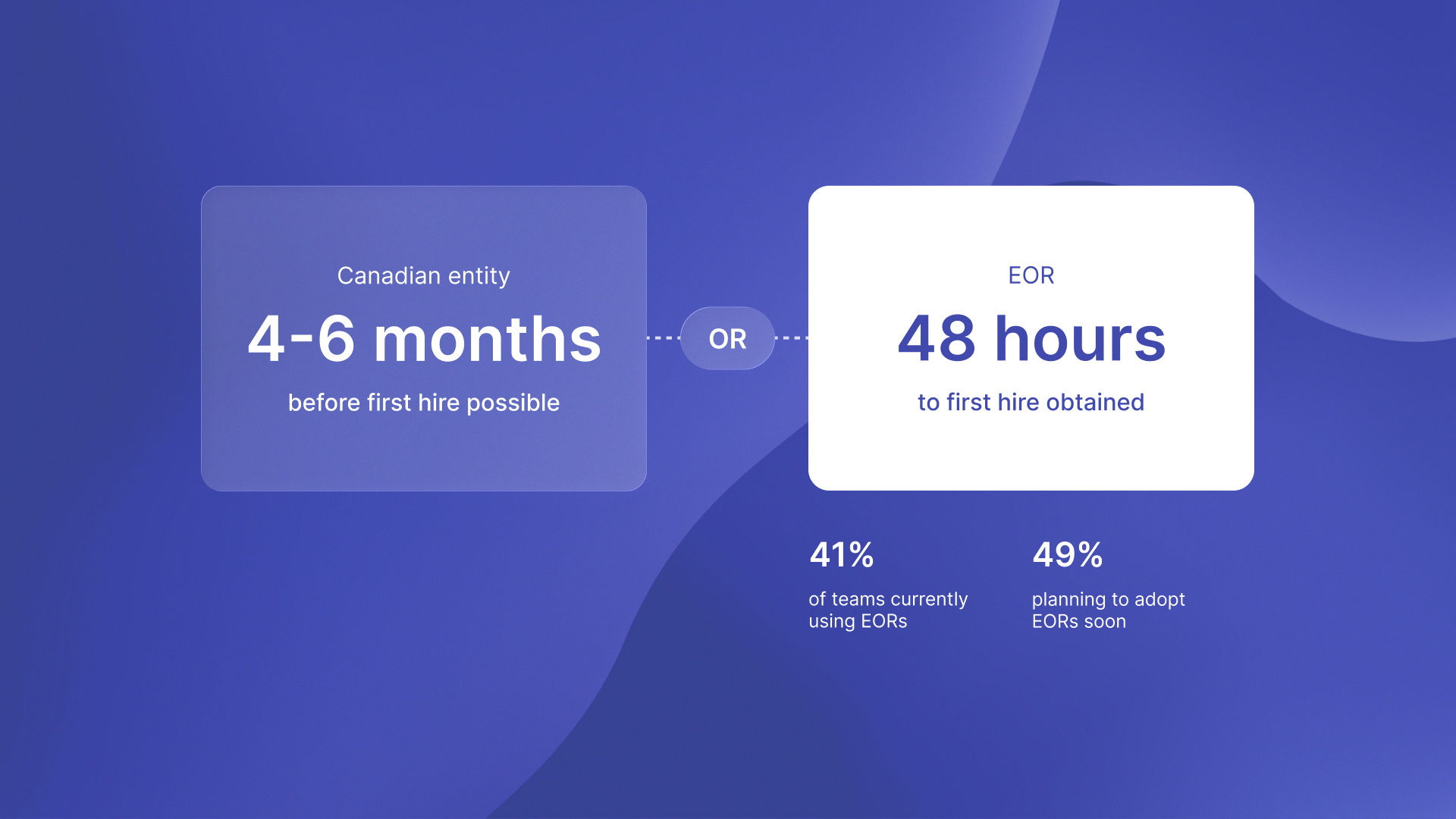
Canadian specialists like Shoreline build compliance into every hire. The 48-hour onboarding advantage only works when compliance is handled correctly from day one. Companies hiring Canadian tech talent can avoid these traps entirely by partnering with specialists who know the provincial differences and monitor regulatory changes continuously.
Ready to hire Canadian developers without the compliance risk? Shoreline's Canada-specialized EOR handles provincial variations automatically, from statutory holidays to termination notice periods. Get compliant onboarding in 48 hours.
.png)


.png)


%2520(8).png)