
.svg)
Canadian tech salaries vs US: the 40-50% cost advantage hiding in plain sight


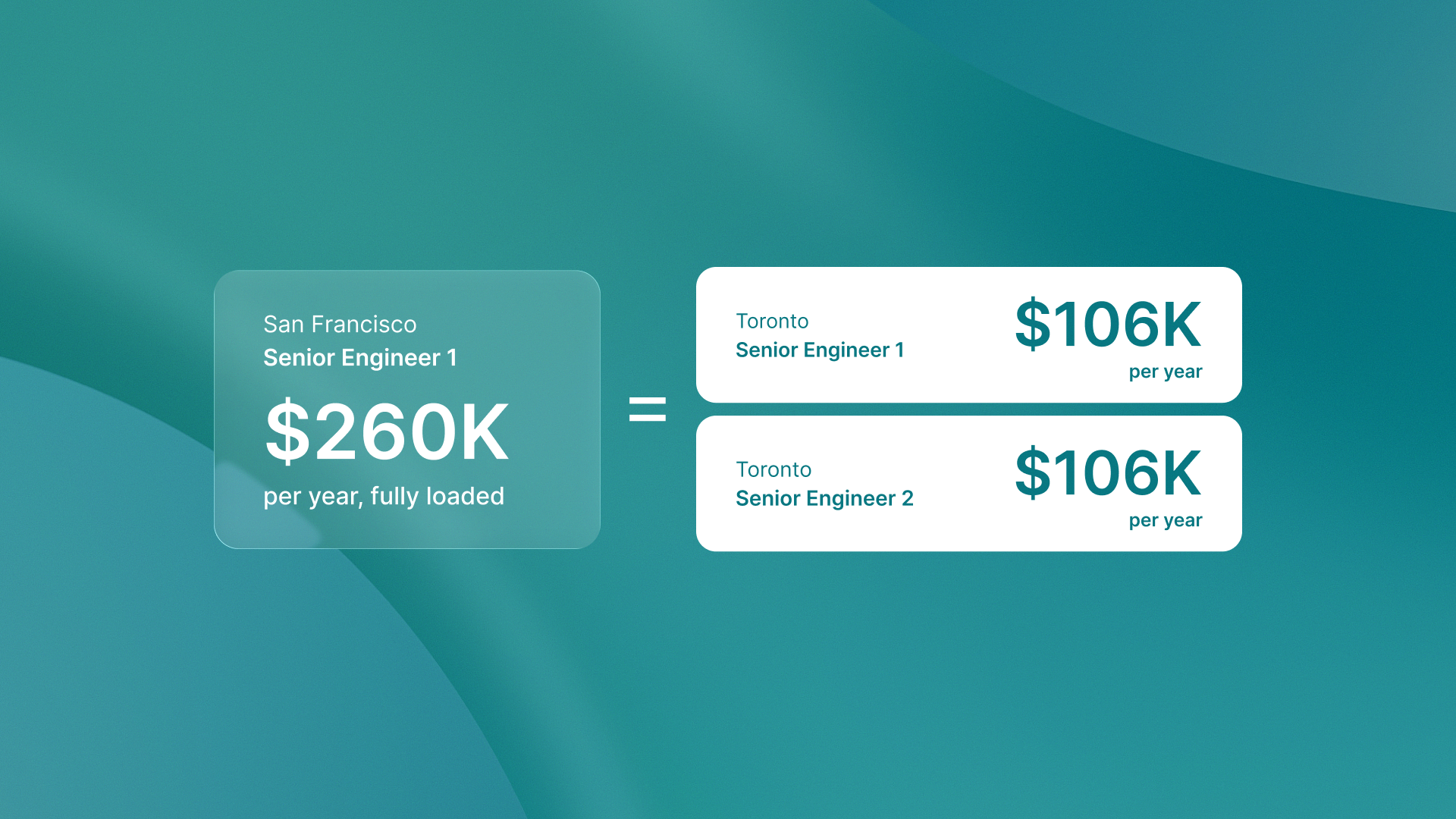
If you pay a San Francisco engineer $260,000, you can hire two similar Toronto engineers for the same cost. You may still have budget left over.
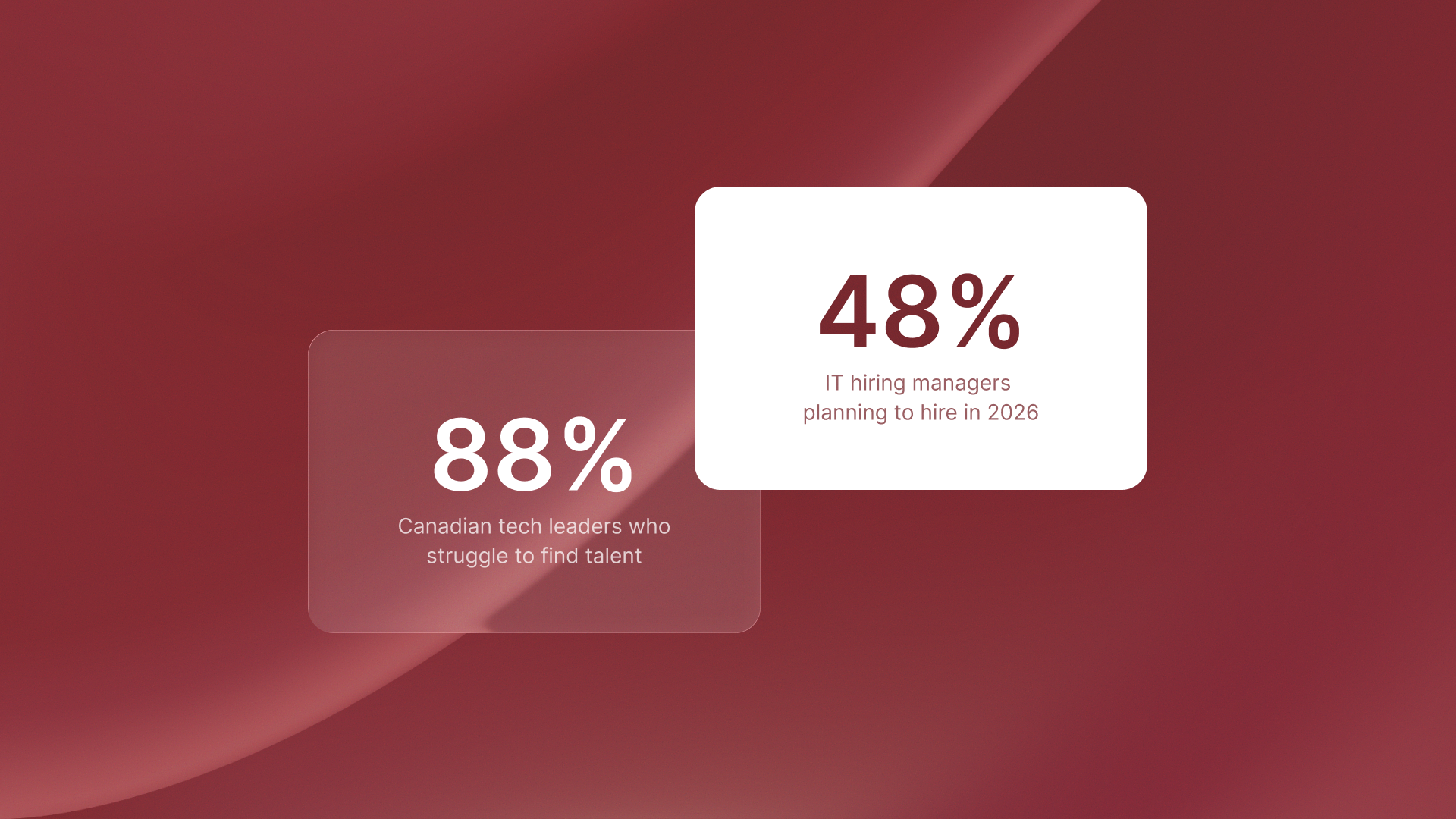
This isn't hypothetical. Engineering costs consume 40-60% of operating budgets at growth-stage startups. As funding becomes scarcer and profitability timelines compress, this isn't sustainable. The solution hiding in plain sight: Canadian nearshoring. Nearly half of U.S. companies already do it. Yet many tech leaders remain unaware of the specific economics when comparing Canadian tech salaries vs US compensation packages. This isn't about cheap labor. It's smart arbitrage that maintains quality while dramatically improving unit economics.
Canadian tech salaries vs US: the 40-50% gap across major hubs
Canadian engineer salaries cost 40-50% less than U.S. equivalents for comparable roles. A Toronto Metropolitan University Dais study found U.S. tech workers make 46% more than Canadian counterparts. Typical Canadian tech employees earn $83,700 versus $122,600 in the U.S.
The Logic's 2025 analysis reveals the US tech salary comparison widens further at senior levels. Toronto engineers averaged around $106,000 in 2023. San Francisco counterparts exceeded $260,000. That's a 145% premium for the same work. These aren't outlier data points. The pattern holds across major tech hubs. Vancouver salaries mirror Toronto's range. New York and Seattle engineers command rates 40-60% above Canadian equivalents.
The arbitrage opportunity is consistent and substantial. Three structural factors create the salary differential:
- The Canadian dollar trades at about 70 to 75 cents per U.S. dollar. This gives immediate buying power benefits when comparing the cost of hiring Canadian developers
- Toronto and Vancouver housing costs are high by Canadian standards. They are still 30% to 40% lower than similar costs in San Francisco and New York
- Canadian tech hubs have strong talent pools without the hyper-competitive compensation dynamics that push U.S. salaries to extremes
Canadian engineers have equivalent education. Waterloo, UBC, and McGill rival top U.S. CS programs. They work in the same timezones and often have U.S. work experience. The salary gap reflects market economics, not skill differential.
The nearshore hiring Canada trend is accelerating
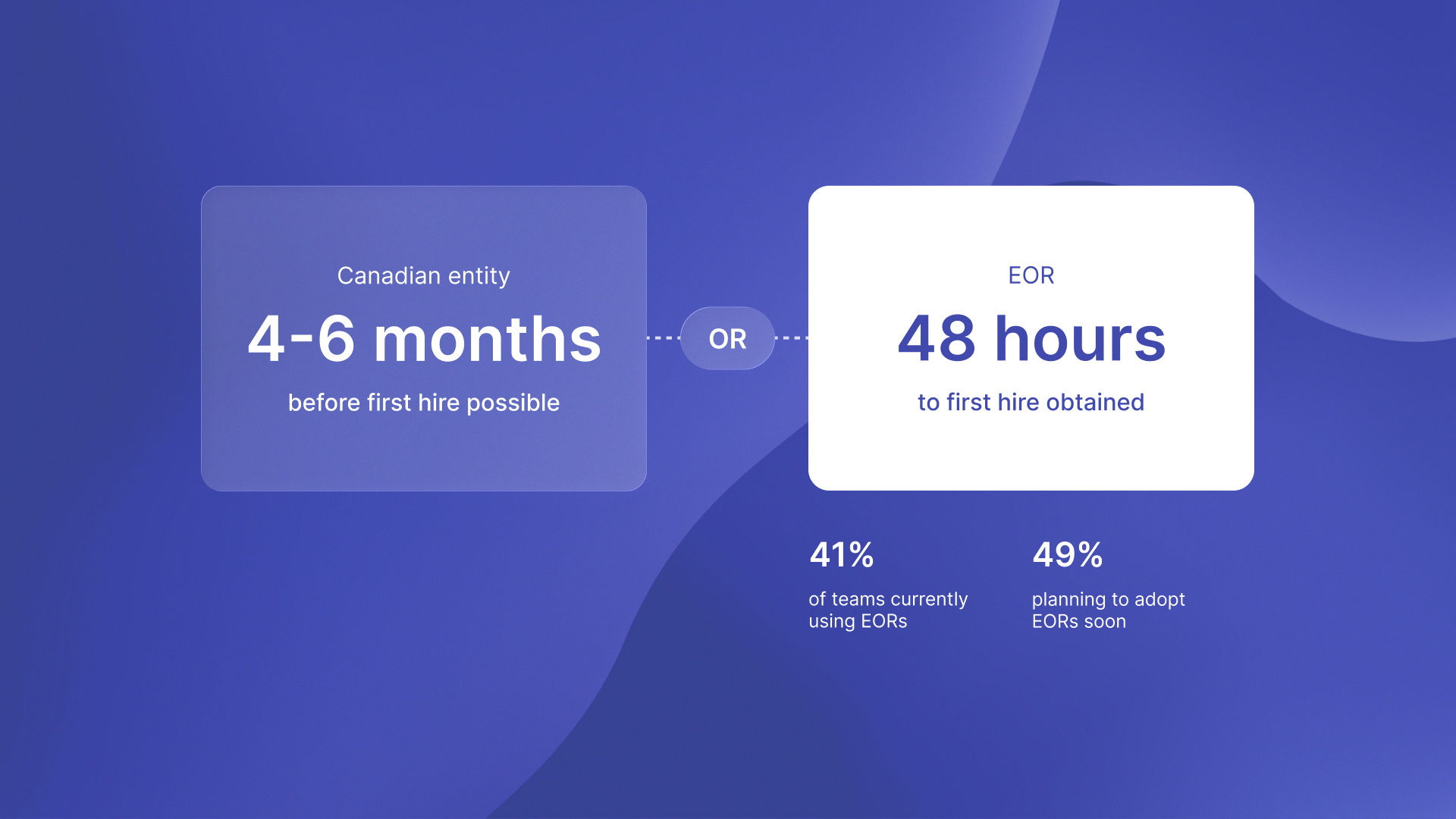
Emapta's 2026 nearshoring statistics show 49% of U.S. companies nearshore IT and software development to Mexico and Canada. Canada leads for technical roles. This isn't a future trend. It's happening now across venture-backed startups and established tech companies alike.
The preference for Canada over other nearshore options comes down to timezone alignment and cultural fit. Canadian engineers work EST and PST hours. Real-time collaboration, daily standups, and synchronous code reviews happen without friction. There are no 12-hour delay cycles that reduce offshore productivity by 20-30%. When your team needs to ship fast and iterate quickly, time zone friction becomes a hidden cost. Offshore options often can’t fix it.
The regulatory environment is familiar. Contract law resembles U.S. structures. IP protections are strong. These factors reduce legal complexity compared to other nearshore destinations. Companies that scale SaaS SEO programs or build growth marketing platforms often hire in Canada. These hires usually fit into existing workflows. They also avoid the extra admin work common with farther locations.
The quality concern doesn't hold up
The natural objection: "If Canadian engineers are cheaper, are they lower quality?" The data says no. Canadian tech education is world-class. Computer science programs regularly rank alongside MIT, Stanford, and Carnegie Mellon. Many Canadian engineers have worked at U.S. tech companies. They bring experience from Google, Amazon, and Microsoft back to Canadian roles.
The salary gap exists because of geography and market dynamics, not capability. A senior engineer in Toronto has 8 years of experience building distributed systems. They do the same work as a senior engineer in San Francisco. They're operating in a market where Canadian engineer salaries at $120,000 are competitive instead of $260,000. The technical output is equivalent. The market pricing is different.
What the math means for your unit economics
A U.S. company paying $200,000 fully loaded for a mid-level engineer can hire an equivalent Canadian engineer for $100,000-120,000 fully loaded. For a 10-person engineering team, that's $800,000-1,000,000 in annual savings. For a 50-person team, the difference approaches $4-5 million per year.
Those savings flow directly to runway extension and profitability timelines. A Series A company that would burn through 18 months of capital with U.S. salaries can extend to 24 to 30 months. It can do this with Canadian nearshoring. The difference between reaching profitability and needing another dilutive funding round often comes down to these cost efficiencies. Reducing engineering overhead creates budget flexibility for customer acquisition and content investment. The savings compound across departments.
Companies executing GTM strategy with lean budgets find the cost differential particularly valuable. Marketing and sales expansion requires capital. Engineering cost reduction frees up exactly that capital without sacrificing product velocity.

Why more companies aren't doing this
If the economics are this compelling, why isn't everyone nearshoring to Canada? Three barriers stand out:
- Hiring in Canada requires a Canadian legal entity or third-party employer of record
- Canadian tax, benefits, and labor law differ from U.S. systems
- Competitive Canadian benefits packages require local market knowledge
All three are solvable with specialist EOR infrastructure. Many companies don't know where to start. The companies moving now are capturing talent before market saturation drives prices up. The early movers who understand Canadian market dynamics capture the greatest advantage.
The window won't stay open indefinitely
Canadian tech salaries have remained stable relative to U.S. rates for years. As more U.S. companies discover the cost advantage, demand will increase and the gap will narrow. Currency fluctuations could also compress the arbitrage opportunity.
The time to act is now. Companies that establish Canadian hiring infrastructure today will lock in cost advantages while competitors continue paying 40-50% premiums for equivalent talent. The nearshoring playbook is proven. The economics are compelling. The question is whether you'll move before the window closes.
Ready to capture the Canadian nearshoring advantage before the market catches up? Start by mapping your current engineering costs against Toronto or Vancouver equivalents and identifying which roles deliver the greatest arbitrage opportunity.
.png)


.png)



%2520(8).png)